Escape to Egypt: Rachel M Allen’s 1888 Christmas Holiday
‘It seems almost impossible to believe that this really is Xmas Day, warm sunshine, blue sky, windows wide open, no sign of a fire anywhere.’
Introduction
For Rachel M Allen (1861-1949), Christmas in 1888 was an extra special occasion. She had swapped the Welsh wintry weather for the hot, sandy, and exotic environs of Egypt. At Pembrokeshire Archives & Local Studies can be found her travel journal of her holiday from Thursday 15th November 1888 to Wednesday 2nd January 1889. Two weeks were spent sailing down the coast of Portugal and through the Mediterranean, where they stopped at Gibraltar and Malta, before they arrived in Egypt. They then embarked on a river cruise on the SS Rameses which saw them explore many ancient Egyptian sites. The journal is filled to the brim with notes on Egyptian antiquities, her encounters with the locals, and – by far the biggest draw – her illustrations. In this blog we take a look at her adventures over the festive period in Egypt.

Christmas
On Christmas Eve, Rachel had remarked how differently she felt compared to normal at that time of year, believing ‘it seems quite impossible to believe that tomorrow is really Xmas Day, it has been very hot all day and we have been trying to evade the mosquitoes.’ It was the day that they had left the SS Rameses, the ship that had taken them on a cruise along the Nile for the previous twenty days. In the afternoon they did a last bit of Christmas shopping, going to the Bazaars in Cairo where they ‘purchased a dozen brass finger bowls’.

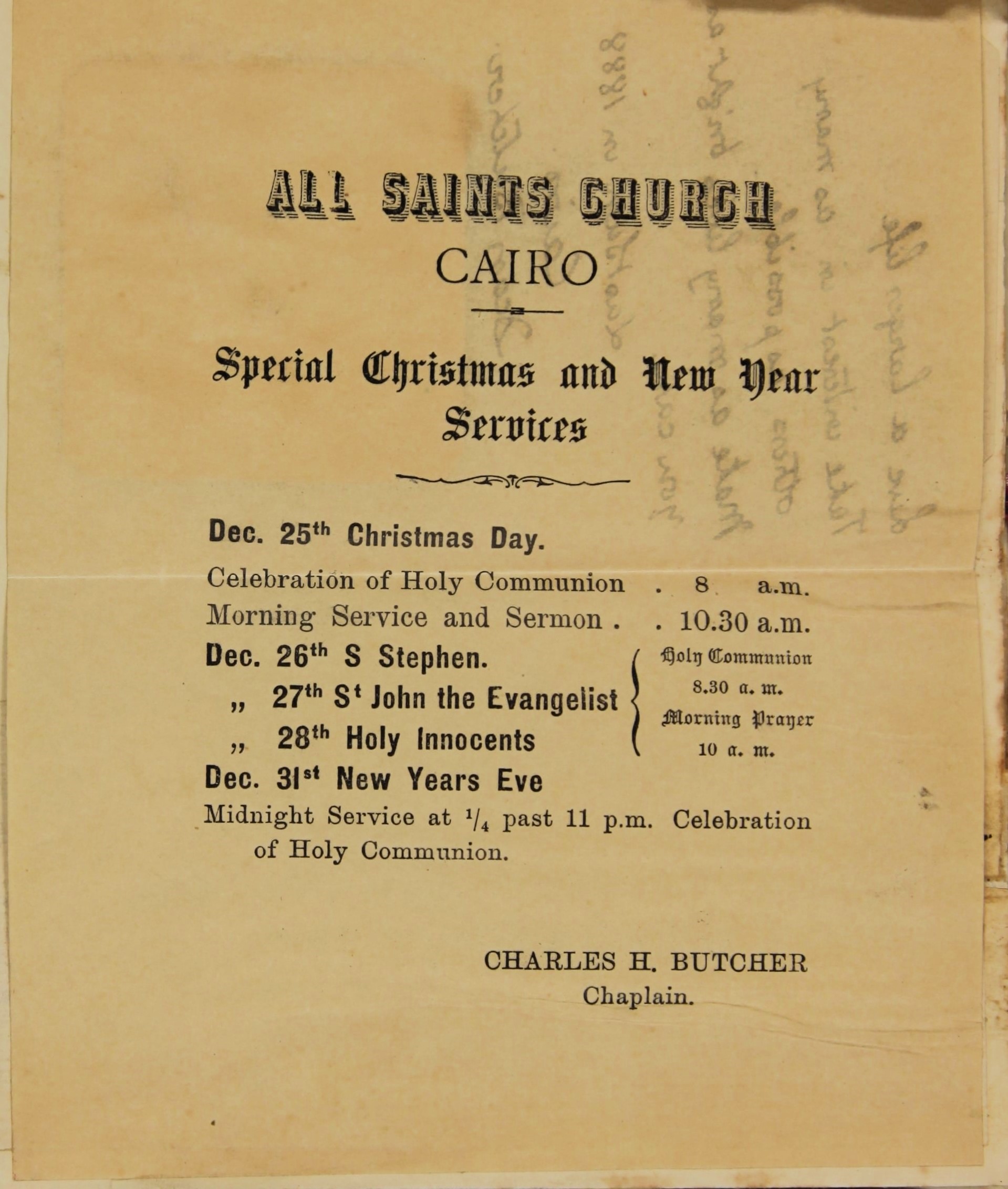
Rachel started Christmas Day at a church service at 8am, followed by another at 10.30am. The church was ‘crowded to overflowing’ and was decorated with myrtle, roses, and palms. A flyer found folded and placed in an in-built back pouch reveals that the services were a Celebration of Holy Communion and a Morning Service and Sermon given by Charles H. Butcher. They were held at the All Saints Church, Cairo, which had been completed ten years earlier. Incidentally, a second church was to open in 1938 that was designed by the grandson of Sir George Gilbert Scott who restored St Davids Cathedral.
After church, they returned to the Shepherds Hotel (where they were staying) and feasted on Christmas dinner. This consisted of roast beef, turkey, plum pudding on fire, and punch. The dining room was decorated with palms, garlands of poinsettias, and pepper plants around the pillars. All guests were each given a bouquet of roses.
Perhaps the first half of the day was not too dissimilar to her usual experience on Christmas Day. But then in the afternoon, she went with her father to the Boulak Museum to view the mummies on display. These included Ramses II and Setti I, which Rachel sketched.
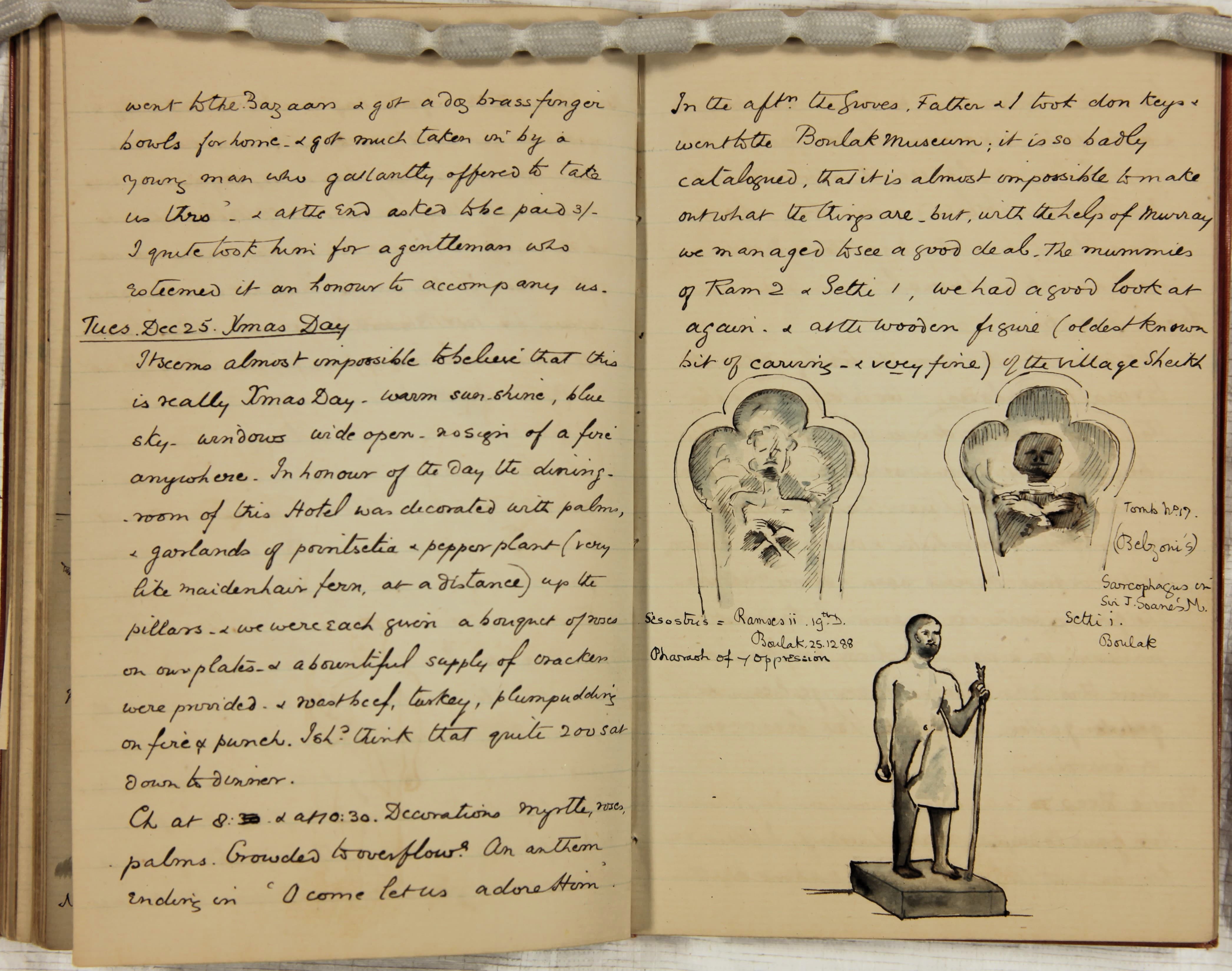
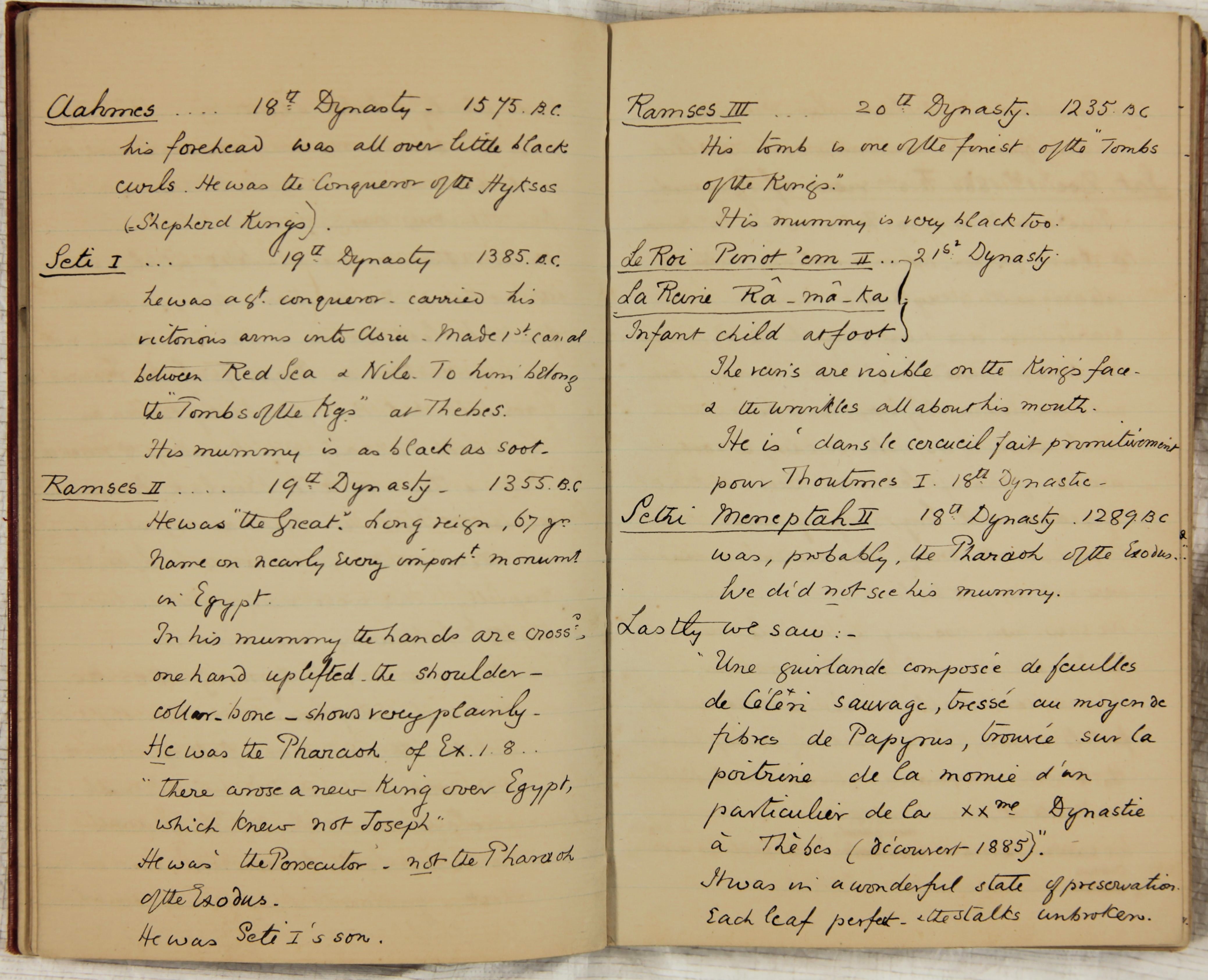
On the same page is a sketch of a wooden figure, which she claimed was the ‘oldest known bit of carving, & very fine’. During their first full day in Egypt on 30th November, they had only been able to spend an hour in the museum. So, to return no doubt was a welcome gift for Rachel, who had previously made notes on nine of the mummies, with one who had his mouth and nostrils crammed full of incense, whilst on the face of another the veins and wrinkles were visible.
The change to her usual surroundings at this time of year was keenly felt, with Rachel ending her day wondering what her London friends would think if they could see her as she rode without side saddle and reflecting that ‘it is curious to be in a country where Xmas Day is not kept’ as people were at work as usual.
Boxing Day
Instead of attending church, Boxing Day morning was spent securing permits to view two palaces in Cairo, which they then saw in the afternoon. Unfortunately, they were ‘by no means worth a visit, all stucco, lath and plaster and gawdy “French” furniture in bad taste.’ Compared to the tomb of mummies, obelisks, and ancient temples that they had encountered every day on their Nile cruise, there’s no surprise that Rachel found little enjoyment in modern fashions.
The next day proved far more interesting to Rachel, when she visited the University of El Azhar, ‘the principal University of the Mohammedan world.’ She described the courtyard and classrooms, noting how the students were seated on the floor in circles round their teacher. In particular she focused on one boy who used a stick of bamboo for a pen, wrote on pieces of tin, and held an ink pot between his feet. The lessons they were taught included grammar, algebra, arithmetic, logic, philosophy, theology, and the Koran. Of the last, Rachel remarked:
‘It struck me as most remarkable to find hundreds of youths, deeply engrossed in studying their ‘Bible’. We should not find the same thing going on at Oxford or Cambridge…It is sad to think that while we Christians are fighting among ourselves and excluding all Bible teaching as much as possible from our places of education, the Mohammedans are making the Koran their chief and most engrossing study.’
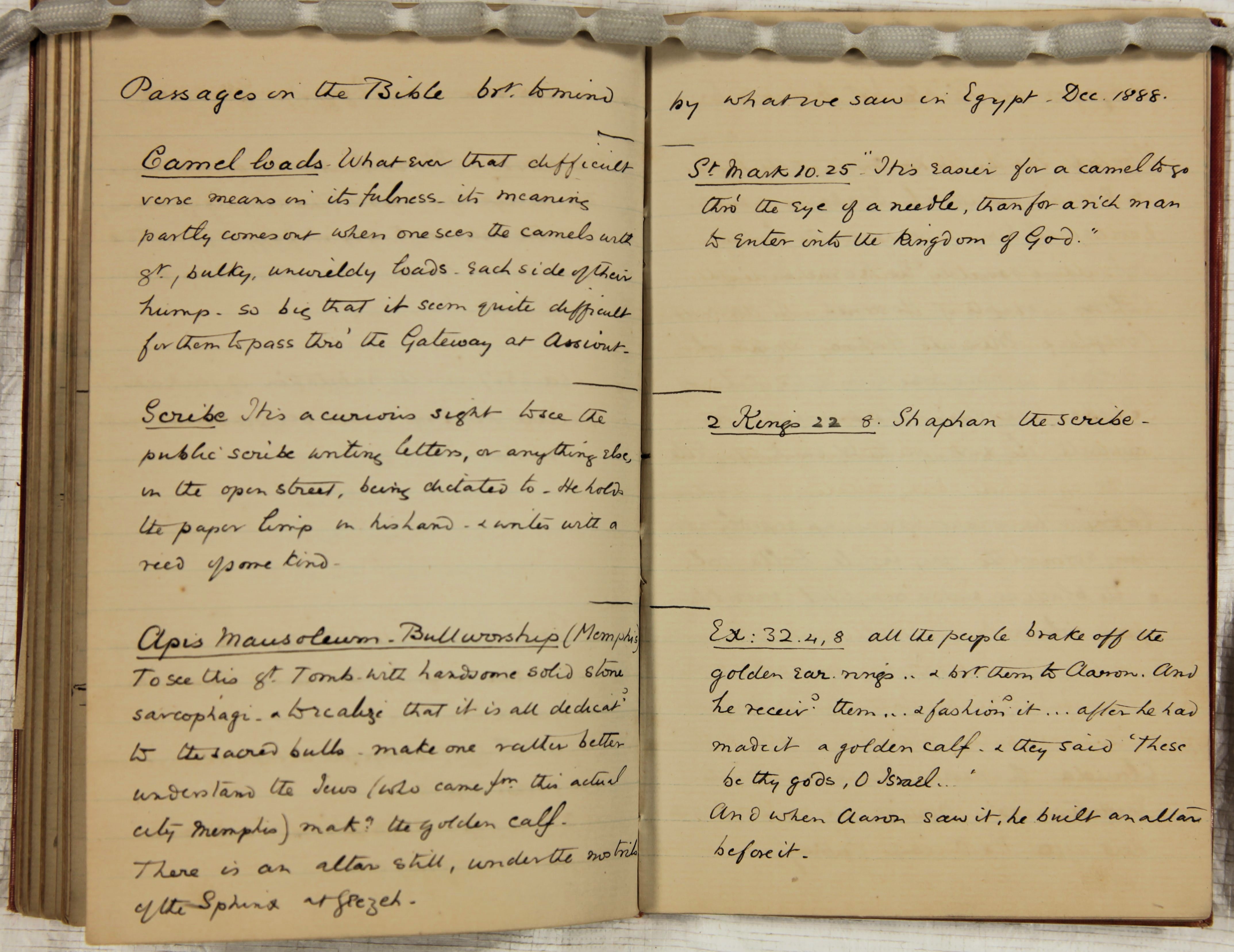
Throughout the journal it is clear that Rachel was a deeply religious woman. Not only did she frequently attend church whilst on holiday and make acquaintances with members of the church, but there are also nine pages at the end in which she compares her experience to passages from the Bible. For instance, camels reminded her of the ‘eye of the needle’ passage from Mark, whilst the hot sun reminded her of Psalm 121:6 ‘The sun shall not smile thee by day.’
The pages relating to the university are indicative of her observations of the people and culture of Egypt. The people proved just as curious to Rachel as the ancient relics. Their clothing, trade, and industry are observed with Rachel for example including sketches of the shaduf – a device used to raise water from the Nile.
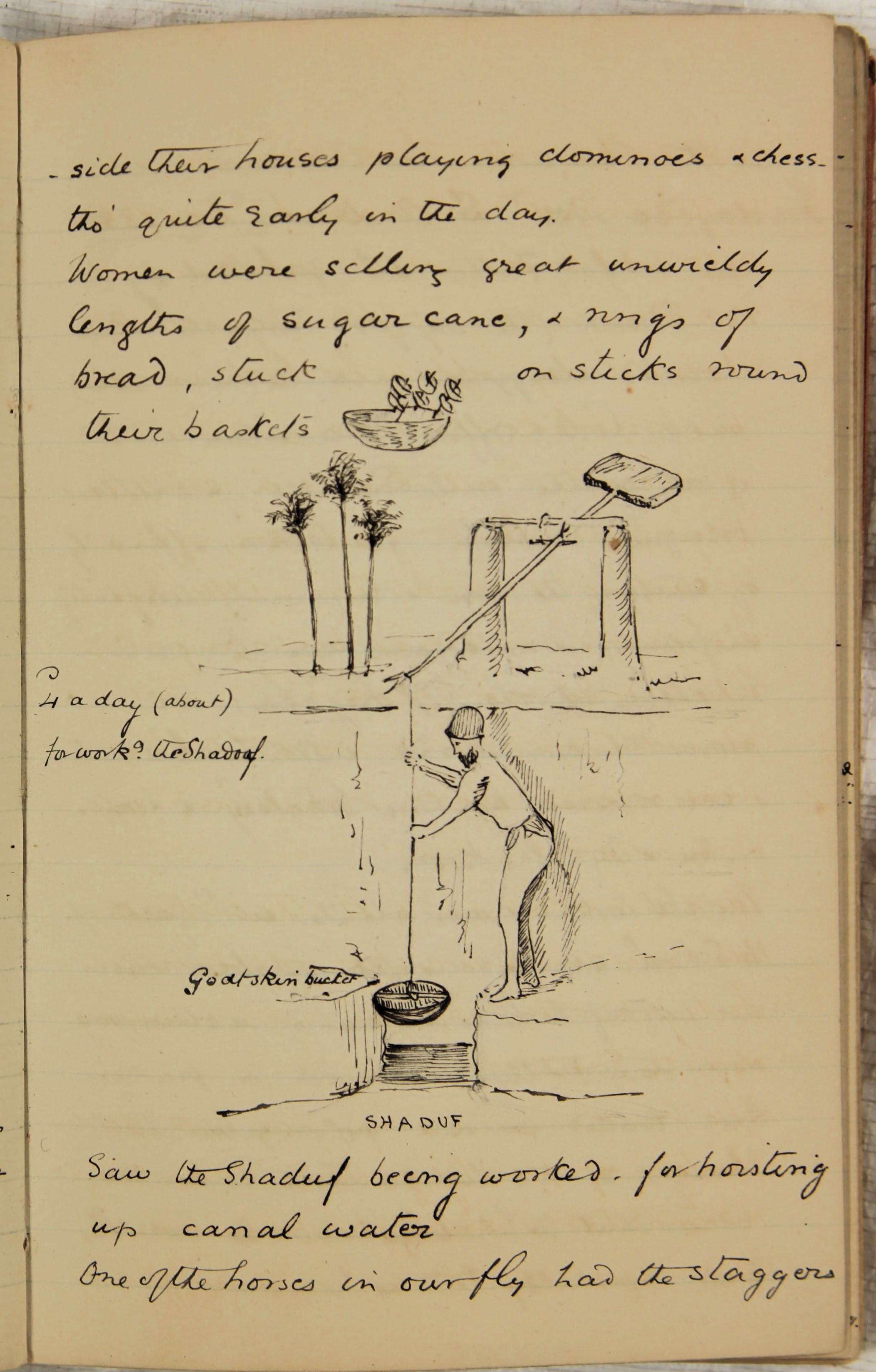
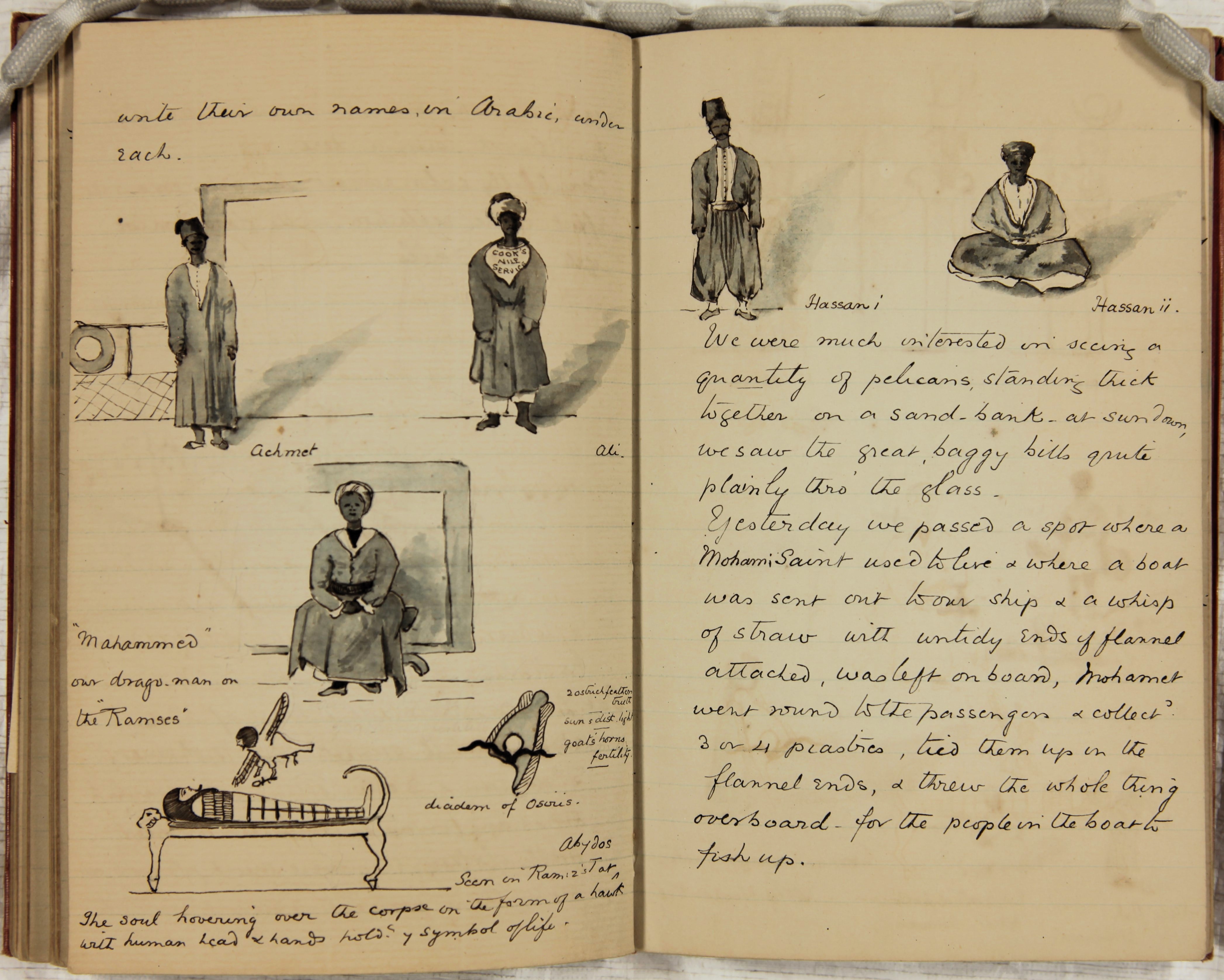
Whether it was on a train, whilst riding camels, jostling through markets, or scrambling up the Great Pyramid, the actions, mannerisms, and appearance of the locals left an impression on her. There is a degree of reproach towards the people’s standard of living with Rachel bemoaning their nakedness, uncleanliness, and cruelty towards animals. A constant occurrence throughout are people of all ages asking for backsheesh, even at times hounding and chasing her and her companions. The frequent reminder of this gives the impression of a beggarly population. For the most part though, Rachel’s observations read as more of an earnest realisation of just how dissimilar life was between two very different cultures, mainly on account of their religion and climate. She also provides a lot of insight into her guides, and even visited the wife of one of them. Before she returned to Cairo from the Rameses, she made sure to sketch her guides and let them write their names in Arabic underneath.
New Year
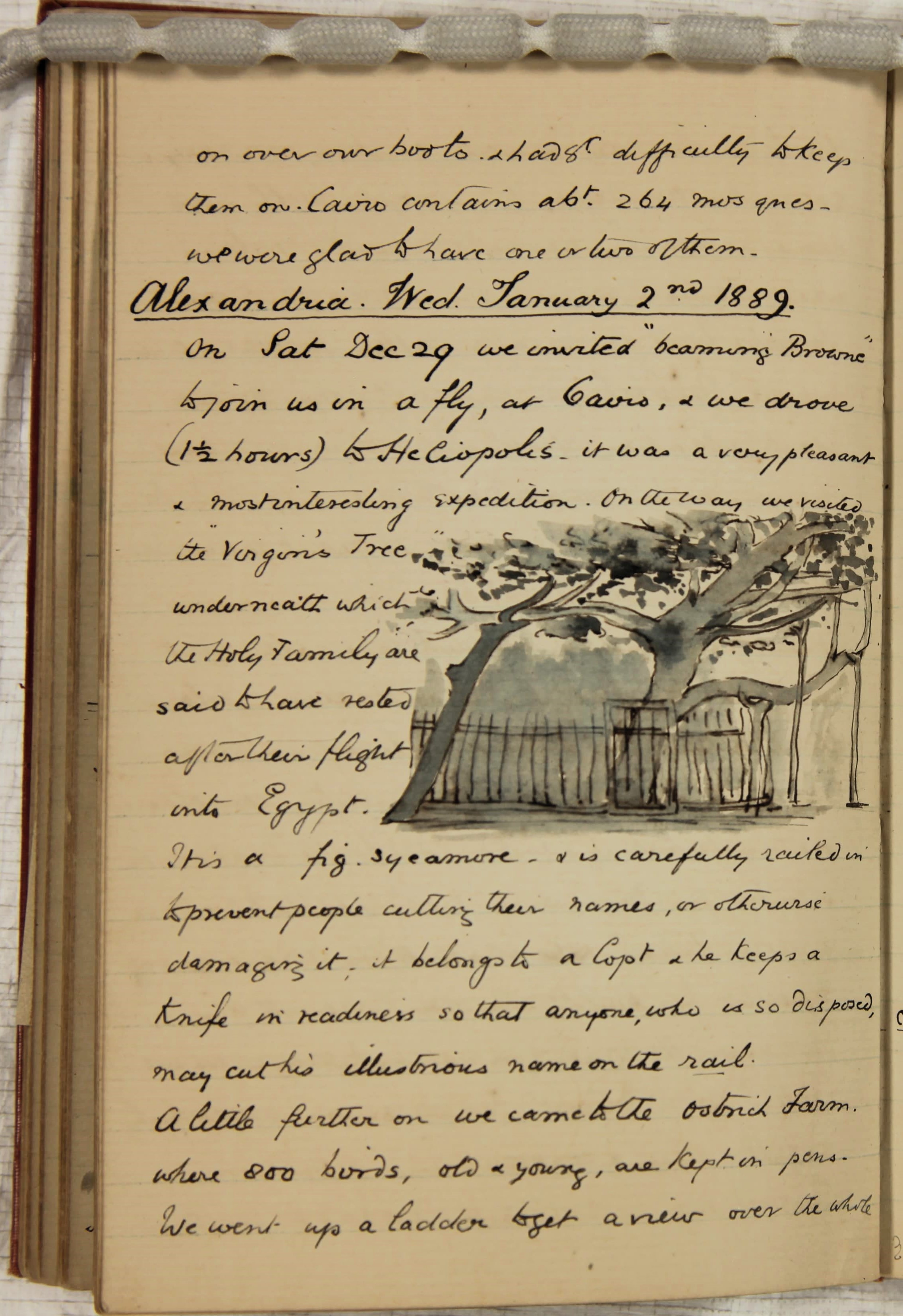
Unlike for a lot of us these days when the time between Boxing Day and the New Year can disappear into the void, Rachel was very busy to the point that her next entry after the 27th was not until Wednesday 2nd January 1889. On Saturday 29th, she travelled to Heliopolis with her father and ‘Beaming Browne’. This was Mr Browne whom they had befriended on their first day. After their initial meeting, Rachel had described him as ‘the very good tempered, white-bearded clergyman, with the velvet cape’, and later as ‘a Devon parson, out on a holiday, intensely pleased with everything’. Their day together followed suit, it being ‘a very pleasant and most interesting expedition.’ On the way out of Cairo they stopped to see ‘The Virgin’s Tree’ a sycamore under which Mary was said to have rested during the flight from Egypt. Around the tree were railings that prevented people from carving their names or otherwise damaging it, and instead they were allowed to write on the railings. Such conservation concerns are another feature of Rachel’s thought process when she encountered sites of historic interest.
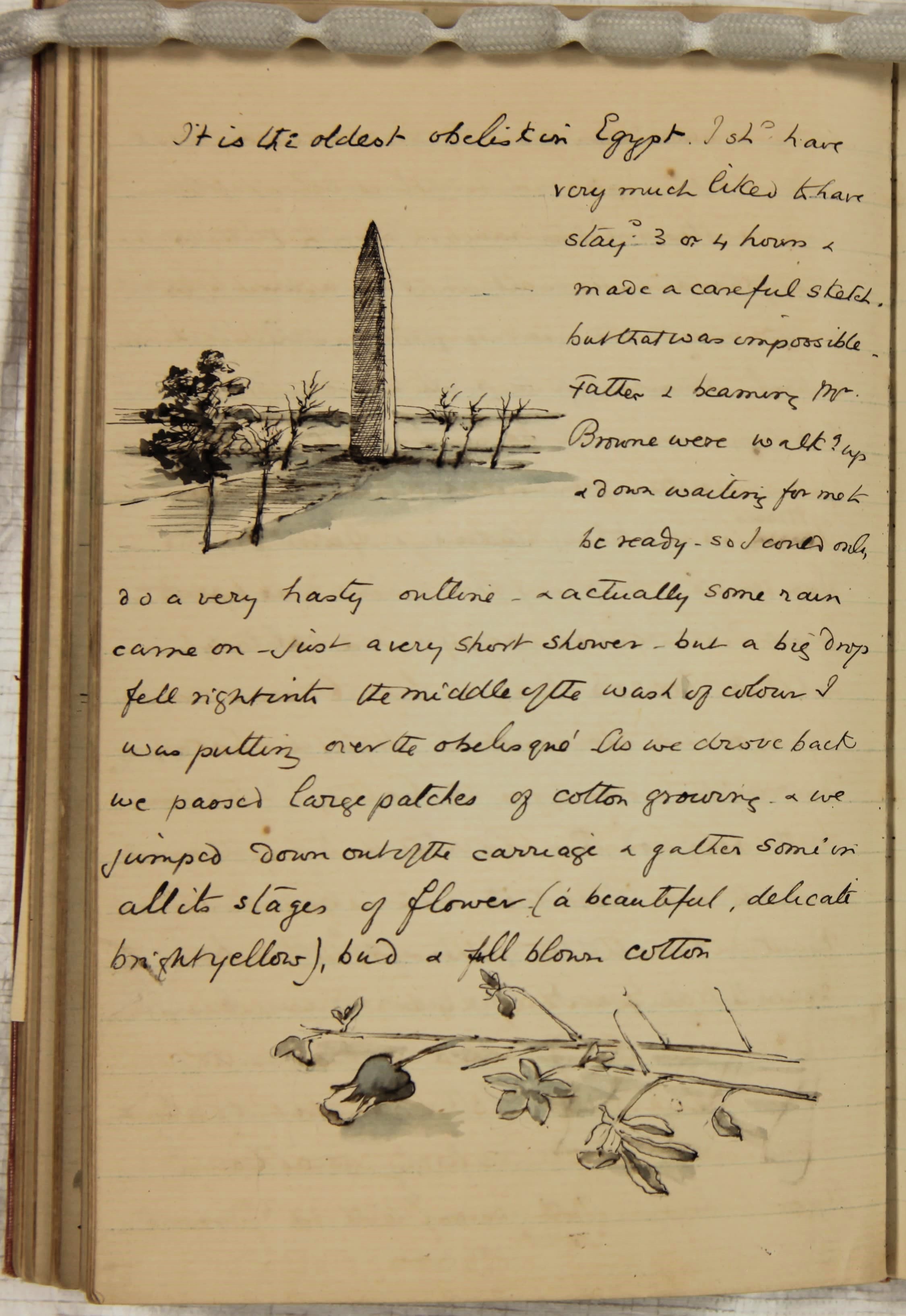
After being entertained at an ostrich farm that housed eight hundred birds, they arrived at Heliopolis, which was steeped in significance. It was said to be where both Moses and Plato studied, as well as the home of Joseph’s father-in-law, who was a priest. The main thing to see on their visit, however, was one solitary obelisk, ‘the oldest in Egypt.’ Despite the scant remains, Rachel wished she could have stayed another three or four hours to make a careful sketch, but:
‘that was impossible. Father and beaming Mr Browne were walking up and down waiting for me to be ready, so I could only do a very hasty outline – and actually some rain came on – just a very short shower, but a big drop fell right into the middle of the wash of colour I was putting over the obelisk.’
Fortunately, a ‘hasty outline’ was included in the journal, but not for the first time Rachel referred to a drawing made separately, which unfortunately we do not hold. For whenever the opportunity presented it, she sketched. Likewise, she mentions 28 photographs her father had developed after their Nile cruise. If only we could reunite them! But the images that do exist in the journal beautifully bring her words to life and adds an immense amount of immediacy. For instance, she includes a drawing of one of the ‘beautiful, delicate bright yellow’ cotton flowers she picked on the journey back from Heliopolis ‘in all its stages of flower’. One can easily imagine her sitting down to draw it either on the side of the road or once back in her hotel room.
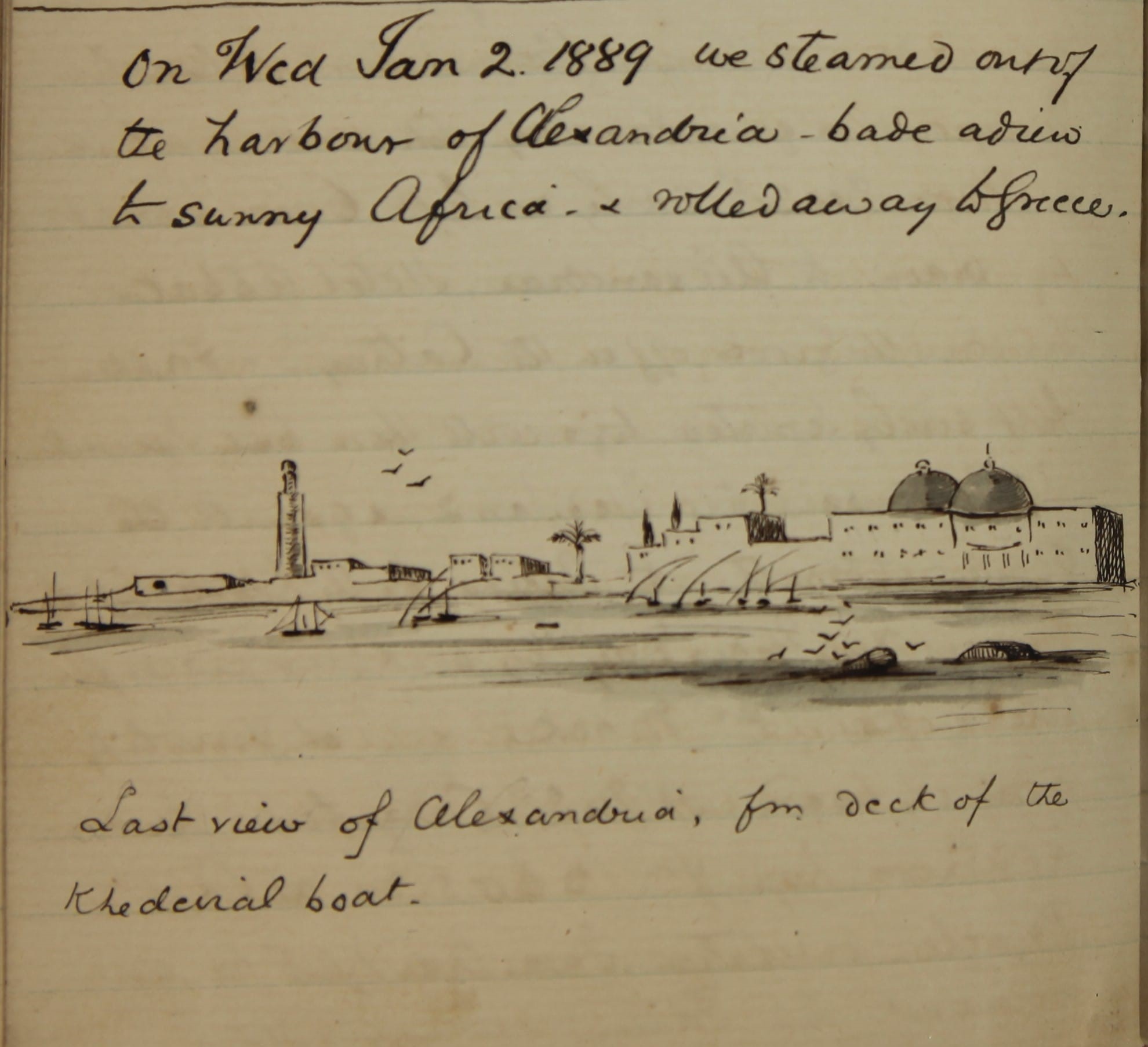
On New Year’s Eve they left Cairo and went by train to Alexandria and spent the morning of New Year’s Day booking places on a trip to Athens. To celebrate the New Year and their last day in Egypt, they attended ‘an afternoon hop’ from 3pm to 5.30pm on the HMS Carysfort, after an invitation from a Captain Pringle. At first though, Rachel seemingly only just remembered it, for she introduces it almost as an afterthought with ‘and then…oh, frivolity…’. In any case, both of them enjoyed themselves with Rachel explaining ‘I was thankful for an amusement for Father and went gladly.’ The next morning, they ‘steamed out of the harbour of Alexandria, bade adieu to sunny Africa, and rolled away to Greece.’
There is no mention within the journal of Rachel attending the All Saints church service at New Year. However, on the reverse of the aforementioned flyer is an inscription by Butcher dated the ‘Last Sun in 1888 Cairo’, so at some point she did at least see the chaplain. The note reads:
‘Live a larger life / Take interest in as many others as possible / Make as many lives bright as you can’.
From this journal alone, it is very clear she already did so.
In the future we hope to share more insights into this journal with you, but in the meantime these (as well as her travel journals for Wales and Switzerland) are available to view at Pembrokeshire Archives & Local Studies.