Preserving Our Digital Content: Celebrating Communities

This Thursday, November 7th we celebrate World Digital Preservation Day. Our first blog from National Library of Wales is about some of the challenges faced when processing hybrid multi-media archives.
Layers in the Landscape: a hybrid born-digital/traditional archive at NLW
An increasing amount of archival material comes to the National Library of Wales in either a hybrid or a fully digital format. To deal with these, the Library is developing new workflows for acquisition, ingest, cataloguing, storage and dissemination.
Much of this material is ‘born digital’: text, video, audio or images that have been produced or created in digital form, rather than having been converted from analogue equivalents. Just like any other document, born digital files are at risk from the day they are created. Future accessibility is threatened by format obsolescence (software is not available), data rot (deterioration of storage media) and information rot or bit-rot (data not readable).
The Library uses Archivematica to gather all the information required to preserve and maintain access to digital objects. Archivematica is an integrated suite of open-source software tools which have been configured to systematically carry out virus scans, file format identification, file normalization, checksums verification, record access and digital preservation rights. It has been configured to work with and report to other Library systems. Archivematica sends a preservation copy and metadata to the Library’s digital archive, and it also provides access copies for users to view on the catalogue. The Library has processed a number of archives in this way.
One of the most challenging is ‘Layers in the Landscape’, a hybrid archive consisting of a small box of traditional manuscript, typescript and printed material, several large artworks including canvasses, a banner and a large scroll, and 38 born digital objects in multiple formats (PDF text, JP2 images, MP3 sound and MP4 moving images). Historically, the Library has catalogued manuscript, graphic and printed material separately, but digital technology allows us to include everything except the large artworks in a single archival description in our AtoM catalogue, improving access and making the archival context more readily understandable. (https://archives.library.wales/index.php/layers-in-the-landscape-haenau-yn-y-tirwedd).

Early in the project a pair of ancient red deer antlers were discovered at Borth. They were woven into the project as the crown of the King of the Sea Trees, a stag who represents the spirit of the place.
‘Layers in the Landscape’ (LITL) was a project which applied the concept of interdisciplinary and non-hierarchical ‘deep mapping’ to the submerged landscape of Cardigan Bay, especially the submerged forest at Borth. Inspired by the Mabinogi and the myth of Cantre’r Gwaelod, Erin Kavanagh brought together specialists from a range of creative and scientific disciplines (art, geoscience, archaeology, linguistics, modern and medieval literature, folklore, traditional music and song, film-making and photography) to produce a response to the flooding of Cardigan Bay over 125,000 years. This was done between 2015 and 2018 in the form of academic work and multimedia public events including exhibitions at Borth and Lampeter, under the umbrella of geomythology, which is the study of landscape and story. Public responses were encouraged, and the project was taken to many varied communities around the world.
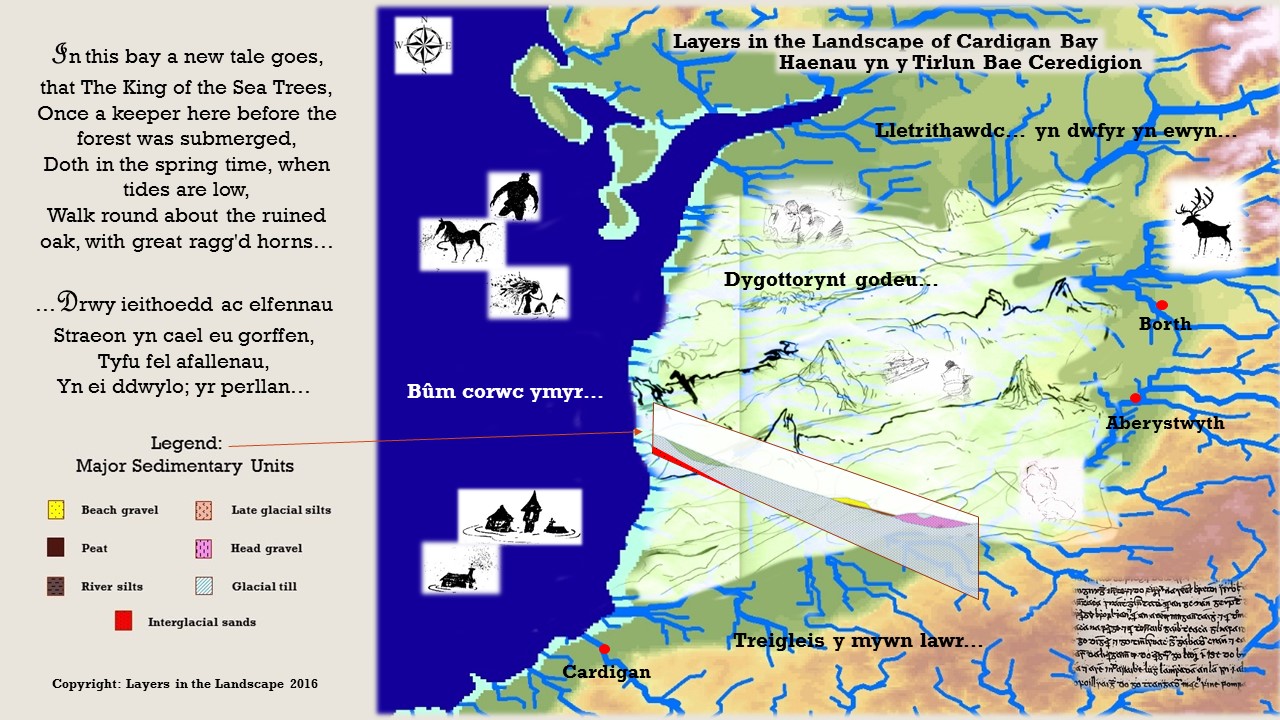
A graphic depiction of the change in the coastal border, the prehistoric antlers and related folklore.
Processing this archive has opened our eyes to new possibilities in cataloguing multi-format archival data. Not many archives will allow us as much freedom to innovate, however – the nature of the LITL project lent itself to our new approach – and we have still had to catalogue the graphic material in traditional formats separately; the compromise would have been greater had we also been dealing with the textiles, sculpture and woodcarving that formed part of the project exhibitions. Nonetheless, we have had a fascinating insight into how apparently disparate and problematic hybrid multi-media archives can be preserved and presented in a more streamlined and easily accessible way than previous practice allowed.