‘Now, wherever did I put that pen?’ thought a Court Clerk in the 1850s…
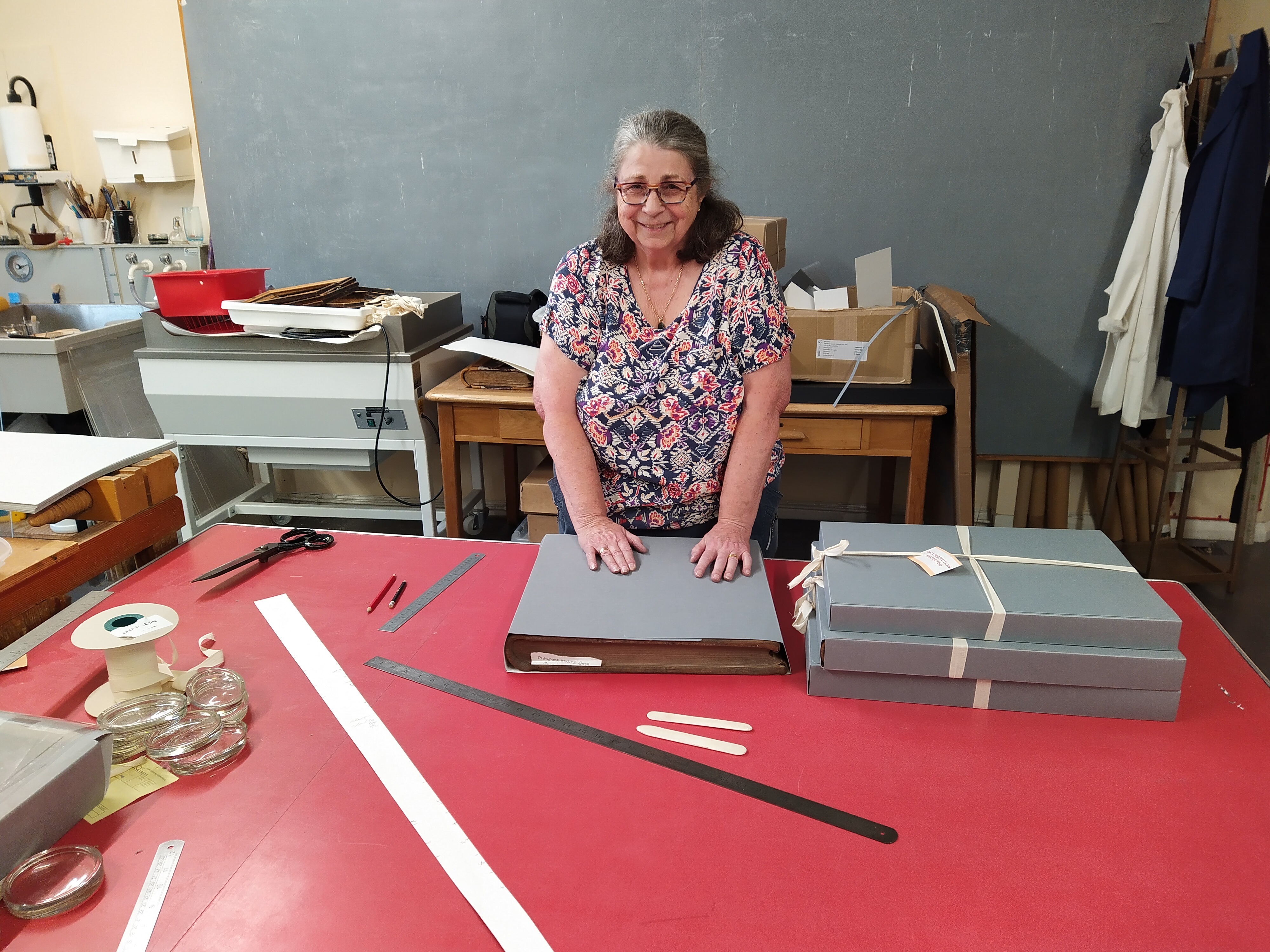
Recently, an original quill pen was found at NEWA, Hawarden, pressed between the leaves of a 19th century Holywell Court plaint book, dating back to the 1850s. The volume was being re-packaged by volunteers, who were making a bespoke box in which to house the fragile original Court Book. The quill feather is pure white and appears to be from either a goose or swan. It is still possible to see ink on the nib, which has been very finely crafted and shaped. The handwriting in the Court volume is very clear, so the quill was obviously of good quality. It appears as if the Clerk had just put it down and forgotten where he had left it… to be found nearly two centuries later!
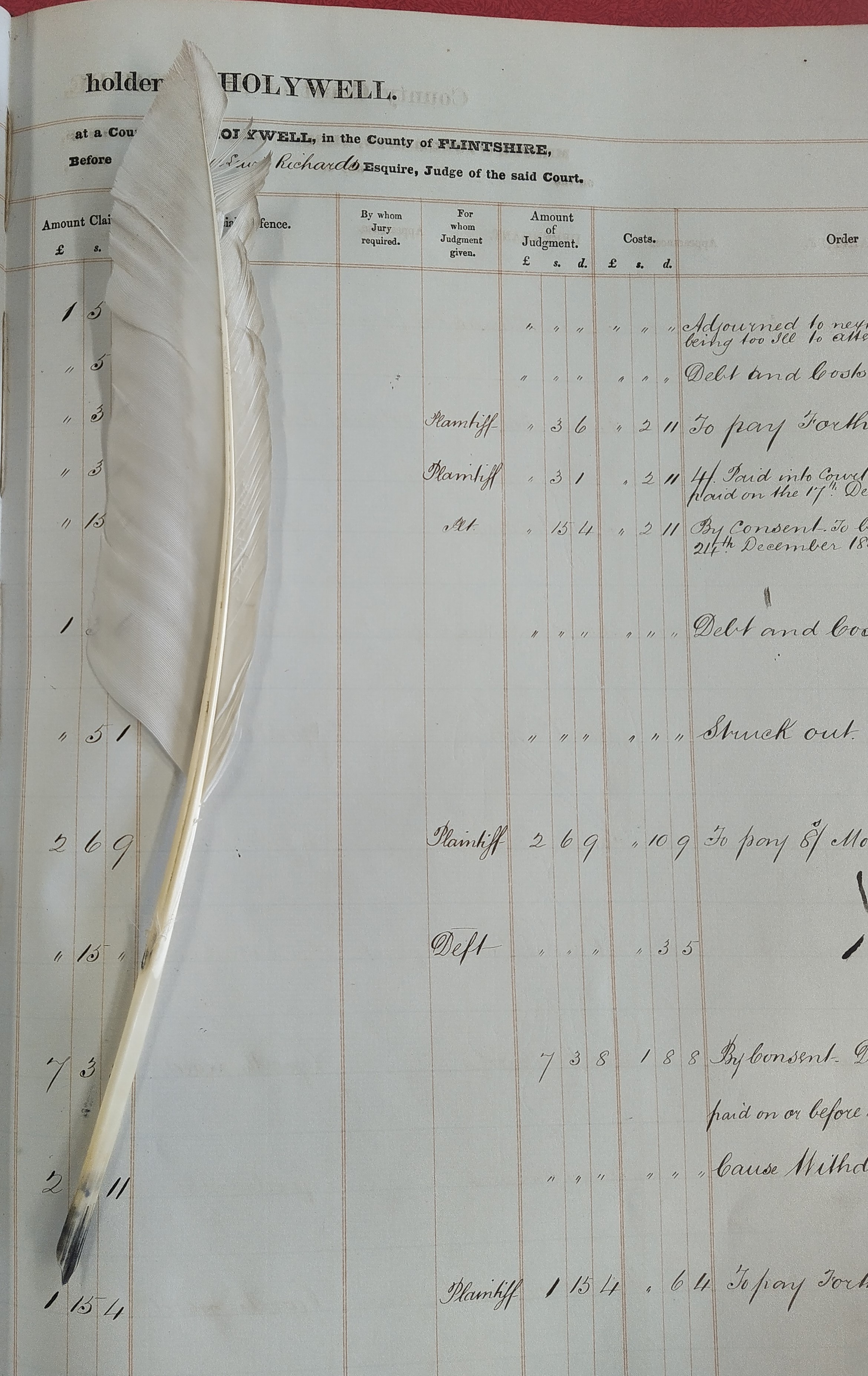
The Court Clerk’s job was to keep accounts of all proceedings of the court and court fees. The signature of the County Clerk, between 1852 and 1856, was that of Samuel Williamson, the eldest son of William Williamson of Greenfield House, an ‘old Holywell family’. Born in 1804, he had a successful career as a local Solicitor and was Chairman of the Local Board as well as being Clerk to the County Court. In the 1861 Census, he lived at Pendre House, Whitford Street, with his wife Mary Ann, two children, and three servants. According to a Return of Owners of Land, 1873, Samuel Williamson Esq. owned 38 acres, 2 roods and 39 perches of land in Holywell, yielding an annual rent of £44-2s.

On his death in 1885 at the ‘ripe old’ age of 81 years, the Flintshire Observer (10th December 1885) printed an obituary which stated that he had ‘won general regard for his integrity and gentlemanly demeanour.’ It seems likely that the quill pen found amongst the leaves of the Court book belonged to him.
Quill pens were used for centuries in Britain and other countries as writing instruments, and the feathers for pens were drawn ‘chiefly from the goose, the swan, and the crow; but the ostrich, turkey, and other birds occasionally contribute.’ [1] There was considerable time and skill involved in preparing the feathers for pens, and also trimming the nib to a fine point. Different bird feathers could be used for different purposes: duck feathers were generally used for writing pens; whilst ‘Crow-quills are usually employed in fine drawings, on account of the fine point to which they can be brought.’[2] According to a ‘Cyclopaedia of Useful Arts’ (1854), a pen-cutter could produce on average around 1,200 pens per day! In the year 1840, more than 22 million quill pens were produced in Great Britain for home consumption.
Quill pens were delicate, and often had to be sharpened and mended by the user, with a knife which became known as a ‘pen-knife’. This was a time-consuming and frustrating business, since nibs did not last very long and could deteriorate in quality quite rapidly. The time spent in mending and sharpening quill pens was considerable and partly explains why they were in decline by the 1850s – when steel pens, largely manufactured in Birmingham from Sheffield Steel, rose steeply in popularity. [3]
However, the plasticity and malleability of a quill pen was still favoured by some over the harder, less forgiving nib of a steel-cut pen. In legal circles, including Court and Government offices, the quill pen was still considered in the 1880s to be ‘as indispensable as red tape’. Quills were thought to improve the standard of handwriting and be less likely to cause ‘writer’s cramp’ than a steel cut pen.[4] In 1884, a trade journal featured an advertisement for quill pens, ‘warranted Hand Cut, thus ensuring a perfect Nib not to be obtained with Machine-cut Pens.’ [5]

Therefore, the use of quill pens was not completely in decline by the end of the nineteenth and into the early twentieth century.
The records of Holywell County Court, between 1847 and 1965, are held at NEWA, Hawarden. County Courts, dealing with civil cases, were created under the County Courts Act 1846. England and Wales were divided into districts, empowered to purchase land to construct a court house. The purpose of the courts was to hear civil cases, and mainly heard cases at its monthly meetings. They dealt with cases for the recovery of small debts concerning contracts, trusts, probate and property.
There were County Courts in Mold and Holywell in Flintshire; and Denbigh, Llanrwst, Ruthin, and Wrexham in Denbighshire; also Corwen (Merionethshire). The Denbighshire records are held at the Ruthin branch of NEWA. Some early records relating to the Ruthin and Wrexham courts have not been transferred to the archives and are presumably lost.
Finding the quill was one of those magical moments where history comes alive through the archives. The ‘lost’ quill will be preserved by our Conservator and kept as an artefact for future posterity, with the Court records. [Ref: C/A/4, Plaint & Minute Book, 1852-1856, Holywell County Court]. Records are available to view at NEWA, appointments are necessary.
[1] Charles Tomlinson (ed.), Cyclopaedia of Useful Arts, Mechanical and Chemical, Manufactures, Mining and Engineering, Vol. II, H-Z, (London, 1854), p.353.
[2] Charles Tomlinson (ed.), Cyclopaedia of Useful Arts, Mechanical and Chemical, Manufactures, Mining and Engineering, Vol. II, H-Z, (London, 1854), p.353.
[3] Charles Tomlinson (ed.), Cyclopaedia of Useful Arts, Mechanical and Chemical, Manufactures, Mining and Engineering, Vol. II, H-Z, (London, 1854), p.353.
[4] The British Trade Journal, (1st November 1884), p.644.
[5] Supplement to the British Trade Journal, (October 1884), p.iii.